

I came across a talk from Keith Rabois. For those who don't know, he is a managing director at Khosla Ventures and a co-founder of Opendoor. He was an early-stage startup investor, and executive, at PayPal, LinkedIn, Slide, and Square.
In his talk, he says that building a billion-dollar company is extremely unlikely. Keith Rabois compares it to making an NBA All-Star team. It takes unusual talent, intensity, and a willingness to do things most people simply won't do.
That idea runs through much of Rabois's thinking about startups. With capital no longer cheap and abundant, founders have to be much more disciplined about time, culture, hiring, and execution.
Here are some of the principles that stand out.
1. Startups Are Never Easy
For a while, there was a popular idea that startups had become something that "normal people" could build. Rabois doesn't buy that.
Building an iconic company is incredibly difficult. The odds are closer to becoming an NBA All-Star than starting a normal business.
Capital makes this even more important. When money is cheap, founders can afford to waste time and experiment longer. When capital is expensive, every dollar and every month of runway matters.
Rabois also pushes back on the idea that companies only need a "wartime" mindset during a crisis. His view is simpler: startups are always hard. There is always a reason to move faster and operate with urgency.

2. Time Is the Enemy Early On
Early in a startup's life, time works against you.
Every day you spend without finding product-market fit is another day of burn. Rabois has suggested tracking the number of days since launch in board meetings as a simple reminder that time is not free.
The interesting part is what happens once the business starts working.
Before you have momentum, time is working against you. Once you have a profitable, growing business, it starts working for you. Every additional day can make the company stronger and more valuable.
The goal is to get from one side of that equation to the other as quickly as possible.
3. Transparency Helps People Make Better Decisions
Rabois is a strong believer in radical transparency.
The reasoning is pretty straightforward: if you want employees to make good decisions without constantly asking for permission, they need enough context to understand why the company is making its decisions.
A CEO sees the whole picture but most employees don't. When someone makes a decision that looks obviously wrong from the top, it may simply be because they didn't have the same information.
He has shared board decks, excluding sensitive compensation information, and meeting notes with the broader company.
The point isn't transparency for its own sake but it's about giving people enough context to operate independently. It also leaves less room for rumors and speculation to fill the gaps.
4. Culture Should Filter People, Not Please Everyone
Rabois describes great startups as being almost like cults. They have a strong belief about the world that most other people don't share.
That doesn't mean you should literally build a cult (although I would love to). The useful idea is that strong companies tend to have strong opinions.
You shouldn't try to create a culture that appeals to everyone. The culture itself should attract some people and repel others.
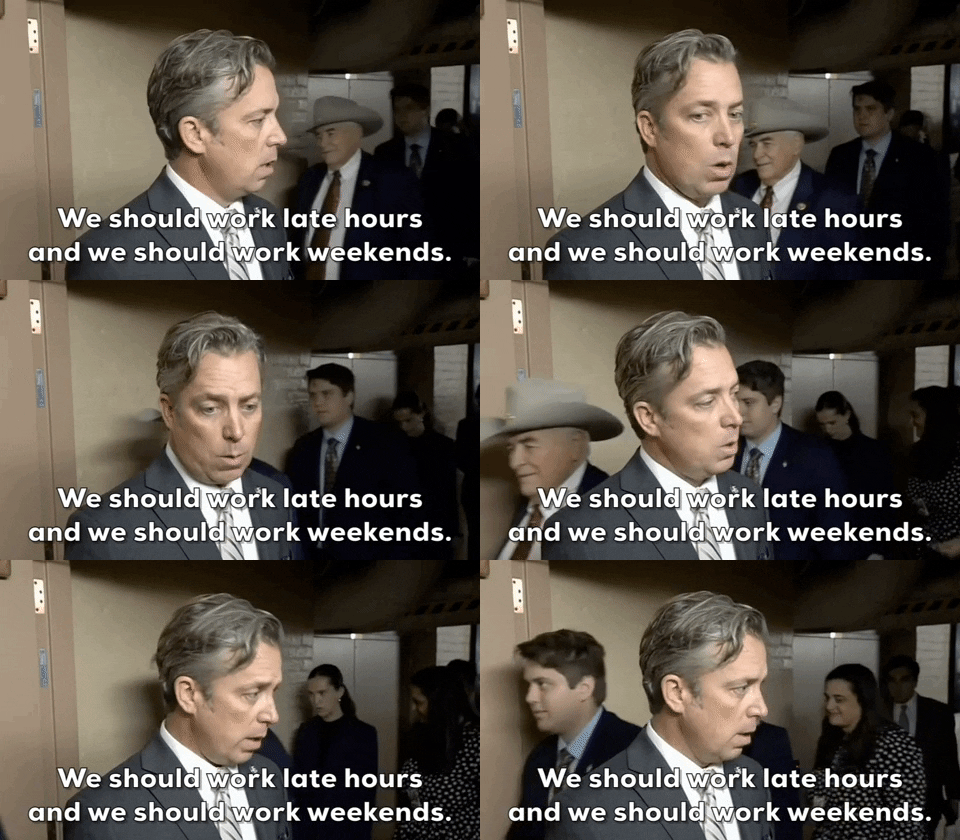
Traba, for example, has been associated with an extremely intense "996" work culture: 9 a.m. to 9 p.m., six days a week. That's obviously not for everyone. But that's partly the point. A demanding culture can act as a filter for people who actively want to operate that way.
The other part is ambition. Everyone in the company should understand how big the goal is. If the goal is enormous, people are more likely to think and act accordingly.
5. What to look for in a Founder
Rabois isn't looking for someone who would make a great employee. In fact, some of the qualities that make someone difficult to manage can be exactly what you want in a founder: being disagreeable, questioning instructions, and refusing to accept that something can't be done.
What he is really looking for is an unusual advantage.
Maybe the person is an exceptional salesperson. Maybe they're unusually intelligent, incredibly persistent, or exceptionally good at identifying talent.
The specific trait matters less than the magnitude of it. Rabois looks for someone who is in the top 1%, or even the top 0.1%, at something that matters.
The underlying question is whether this person has a real chance, however small, of changing the world.
That's a much higher bar than simply being smart or competent.
6. A Simple Formula for Finding Markets
Rabois has also talked about a fairly simple framework for finding startup opportunities:
Fragmented market + unhappy customers = opportunity.Look for industries where there isn't a clear winner and where customers aren't particularly happy with the existing options.
From there, the opportunity may be to vertically integrate the experience.
Apple is the obvious example. Instead of letting different companies control the hardware, software, and user experience, Apple controls much of the stack itself.
The advantage is that you can eliminate the friction between different parts of the experience. Instead of fixing one broken piece, you can redesign the whole thing.

7. Your Body Is Part of the Job
Rabois also treats physical performance as part of being an effective founder.
His argument is simple: you can't consistently operate at a high level if you're exhausted and eating poorly.
He puts particular emphasis on sleep, pointing to research suggesting that getting enough sleep can have a meaningful impact on athletic and cognitive performance. For him, 8-9 hours isn't a luxury. It's part of the job.
He takes a similar approach to nutrition, arguing that most people underestimate how much their diet affects their physical and mental performance.
The broader point is less about following a particular diet and more about treating your body as part of your operating system.

Finding Your Superpower
Perhaps the most useful idea is also the simplest: figure out what you're unusually good at, then build around it.
Rabois suggests asking five close friends and five people you professionally admire:
"What do you like most about me?"
Write down their answers exactly as they give them to you.
Then look for patterns. If the same ideas keep appearing, you've probably found something important about yourself.
That recurring theme is your "word umbrella." It points toward your comparative advantage.
Once you find it, don't try to become well-rounded. Double down on it.
The goal isn't to be good at everything. It's to become exceptionally valuable for something that matters.