

The companies that tend to win in tech over long time horizons are the ones building the physical and industrial base everything else is pinned to: compute, networking, cooling, chips, packaging, tooling, process know-how, and maybe even robots. They sit closest to the parts of the system that are scarce and expensive to replicate.
AI makes this easy to see. A lot of companies right now are wrappers around foundation models. Some will build real businesses. But they don’t control the platform underneath them, so if it changes pricing, rate limits, or distribution, they take the hit.
For years I repeated a single statistic as evidence that Malaysia is central to semiconductors: Malaysia exports 13 percent of the world’s semiconductors. The number is true, but it can mislead you. Export share measures throughput, and throughput isn’t value capture. You can move a lot of product and still sit in a part of the chain where margins are structurally capped.
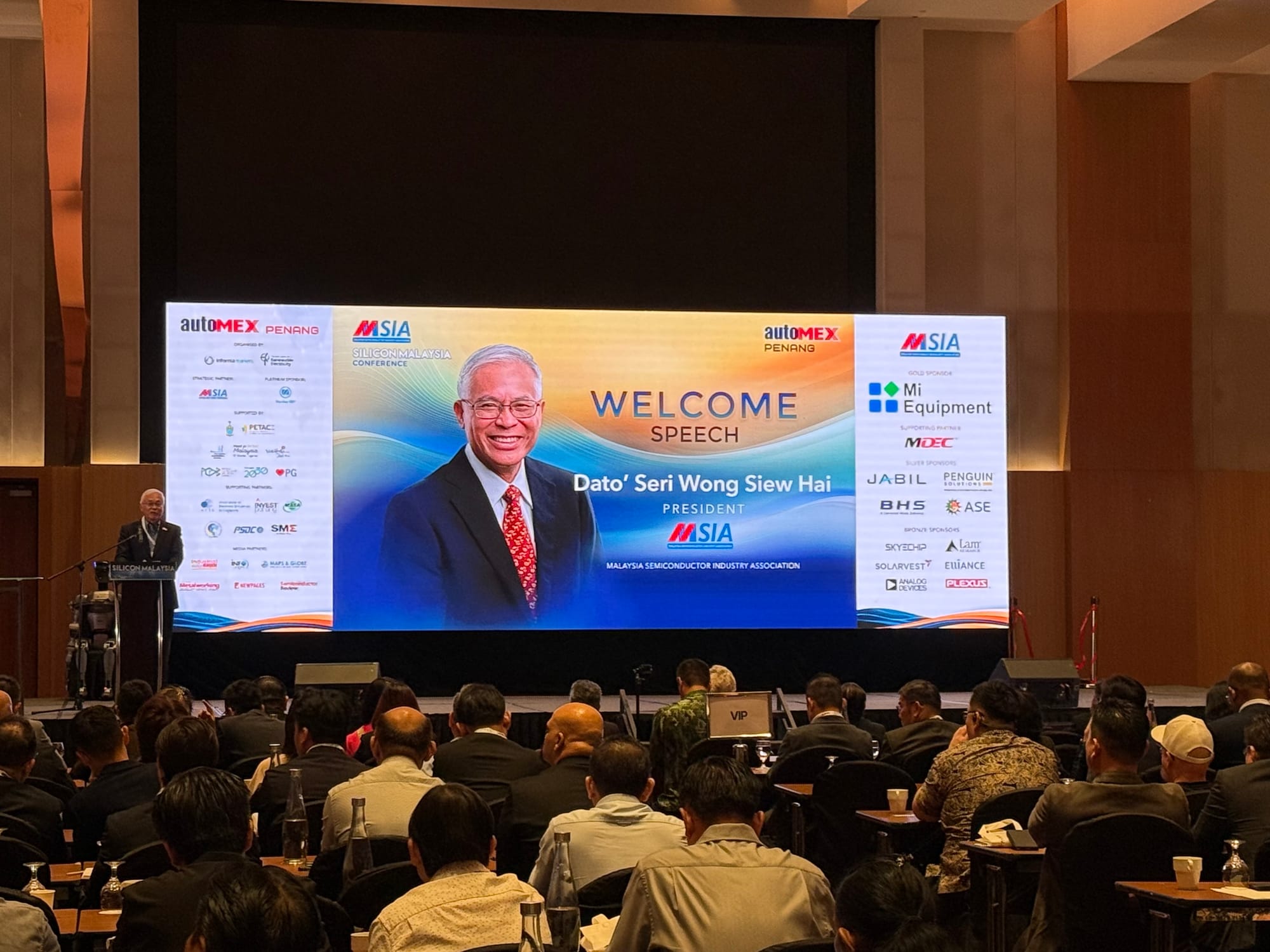
I went to a semiconductor conference in Penang with that number in my head. Not as a patriotic slogan, just as an assumption: we must be closer to the core than people think. After a day of walking the booths, listening to talks, and seeing what companies were actually selling, the conclusion was straightforward. Malaysia is important, but our strength is operational delivery, not the parts of the value chain that set prices through IP or scarcity.
Why? Because most of Malaysia’s semiconductor footprint is ATP: assembly, testing, and packaging. The wafers are fabricated elsewhere, then come here to be diced, tested, packaged, and shipped. That creates jobs, operational skill, and a place in the supply chain. But competition in this segment is intense and margins are thinner, because the work is easier to benchmark and easier to move if cost or policy changes.
The simplest model for this is the Smile Curve. At the left end is R&D and chip design, where IP and differentiation create pricing power. At the right end is market control, distribution, and services, where customer lock-in and brand capture margin. In the middle is manufacturing and assembly, where performance is measured by yield, cycle time, defect rates, and cost. It’s crucial work. But it’s harder to defend, because buyers can multi-source and squeeze.
This is what the middle-income trap looks like in industry. Wages rise, so the cheap-labor advantage fades. Moving to the ends of the curve takes more than capital, though. It takes research depth, specialized tooling, process IP, and a dense talent pipeline, each building on the others. If those don’t accumulate locally, you stay globally relevant but economically capped.
The most common reaction I hear is frustration. Why don’t we just build our own chips?
It’s a dangerous fantasy. Every semiconductor giant started by doing the “boring” work better than anyone else.
The ambition is fine. The trouble is that semiconductor leadership is path dependent. It comes from decades of accumulated process learning and institutional knowledge, which you then use to climb into adjacent capabilities.
Japan is a good reference, because it didn’t begin at the frontier. Early on, Japanese firms like Sony and Toshiba licensed key transistor technology, then got exceptionally good at manufacturing discipline: yield improvement, quality control, process repeatability. Those sound boring. That’s the point. In the 1980s Japan dominated DRAM, a commodity product where small yield advantages add up to massive market advantages. What’s worth copying is the process mastery, because that’s what creates leverage. Once you can operate at high yield with low variance, you can move into more complex, higher-margin categories.

China’s OSAT sector shows a similar ladder. JCET started small and spent decades scaling packaging and test. Its breakthrough came from operational competence plus capital, deployed at the right time. In 2015, JCET acquired STATS ChipPAC. The deal accelerated capabilities and customer access, but it only worked because the base layer was already strong. There was already competence to absorb the complexity.
Which is why skipping steps fails: the step you skip is usually the one that builds the capability you need. Malaysia can’t skip to the finish line either.

Why not build fabs, the way Taiwan did? Because a modern fab is a multi-billion-dollar system that depends on an entire ecosystem: equipment, chemicals, ultra-pure materials, research institutions, and a deep bench of specialized engineers. The supply chain is so complex that even the United States is struggling to re-shore it, despite spending billions of dollars on the problem. You can’t assemble that quickly, and you definitely can’t do it cheaply.
The National Semiconductor Strategy (NSS) has correctly seen this. Our immediate goal shouldn’t be a fab to compete with TSMC. That would be a $20 billion bet, and Malaysia can’t afford to lose it. So the first goal has to be leading the world in advanced ATP.
Advanced packaging is adjacent to what Malaysia already does, and in the AI era it’s increasingly a bottleneck. Packaging is no longer just “wrapping.” NVIDIA’s H100 chips are limited not by how fast they can be printed, but by how fast they can be packaged using “CoWoS” (Chip-on-Wafer-on-Substrate) technology, which stacks chips in 3D structures and connects them with hair-thin wires.
Technologies like CoWoS exist because the hard problems in high-end compute are now integration, bandwidth, thermals, yield, and reliable scaling. The market rewards whoever can deliver advanced packaging at high yield, at volume, with tight reliability. And if packaging capacity is constrained globally, packaging becomes pricing power. That’s how you move up a curve without pretending you can teleport to the top.

What limits all of this is people. Advanced packaging needs specialists: process engineers, materials, test, mechanical and thermal design, quality systems that run at scale. Nobody downloads those skills. They build up over long careers, through tight feedback loops in production.
Malaysia also has a straightforward labor market problem. Engineers can move to higher-paying markets and capture immediate upside. If local roles don’t offer comparable technical growth, compensation, and prestige, keeping them is hard. Over time that becomes a ceiling. Not because Malaysians aren’t capable, but because the system doesn’t let expertise accumulate locally. That’s why talent pathways need to be treated as infrastructure.
A semiconductor manufacturing system can cost hundreds of millions of dollars. Malaysia doesn’t need to build the whole machine to capture value. It needs to make the crucial part inside it: the subsystem that’s hardest to replicate and most painful to be without. Call it the 2 Million Dollar Part Theory.
Penang already has examples. ViTrox builds inspection and machine vision systems, which sit in the metrology and yield control loop. Test socket companies build the interfaces that connect chips to testers, a niche that isn’t glamorous but is indispensable and precision-heavy. These work because the engineering difficulty is real and the learning curve is steep.
Getting there takes three parties, which I call the Trifecta. The student commits to mastering the hard sciences, knowing the effort will pay off. The government funds R&D, not just the “D” (Development). The corporation provides a place to experiment, and a guaranteed career path for students who earn the specialized degrees the industry demands.
We need to stop trying to do everything at once: AI, fab, design, OSAT. We need to find the one boring, difficult, high-precision part of the supply chain the rest of the world can’t live without, and be the best in the world at it. Japan and China both did it this way, and it’s how Malaysia will escape the middle-income trap.
So the practical question is which adjacent capability Malaysia can build from where it already sits. Advanced packaging is a plausible answer, because it’s close to our base, globally constrained, and rewarded with higher margins when done at high precision and high yield. The same logic applies to narrower components: inspection, test interfaces, metrology, and the specialized subsystems that become bottlenecks. What these have in common is a steep learning curve. Malaysia doesn’t need many of them. It needs a few, held long enough for the advantage to build until the market treats Malaysia as a default dependency.